Explainer · Fig. 03
The science of autostereograms
A flat sheet of repeating texture contains no picture at all — until two eyes and one brain conspire to build a third dimension out of it. This page explains why the illusion works, from retinas to render loop. (For the hands-on technique, see How to View.)
Depth from two viewpoints
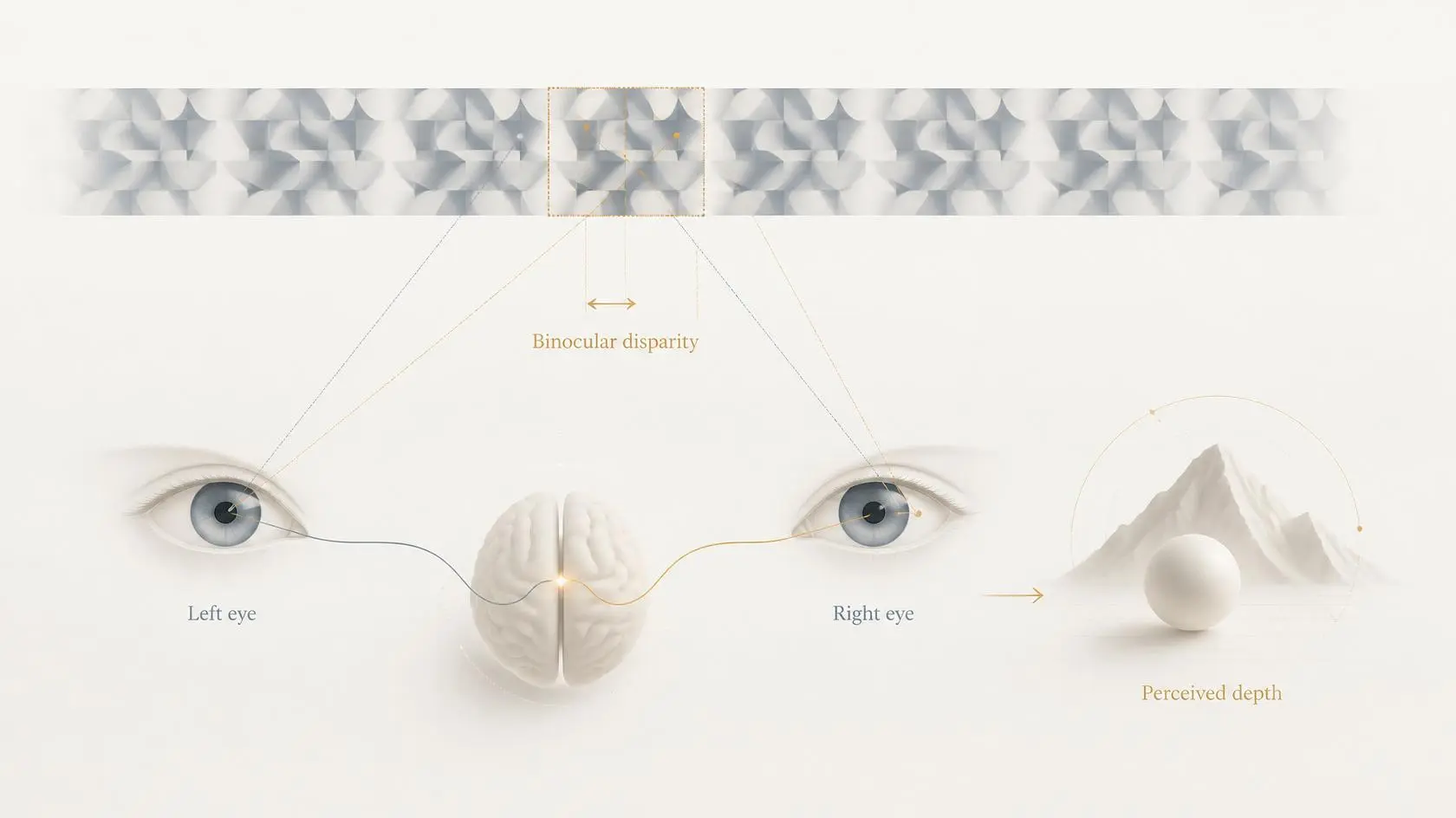
Your eyes sit about 6 cm apart, so each one receives a slightly different image of the world. Nearby objects shift more between the two views than distant ones. This difference — binocular disparity — is one of the strongest depth cues the human visual system has. Neurons in your visual cortex are literally tuned to specific disparities: some fire for "slightly nearer than where I'm looking," others for "slightly farther."
Stereoscopes, invented by Charles Wheatstone in 1838, exploited this by showing a separate photograph to each eye. An autostereogram achieves the same effect with a single image and no apparatus — the "auto" part — by hiding two eye-views inside one repeating pattern.
The correspondence problem
To compute depth, your brain must first decide which feature in the left eye's image matches which feature in the right eye's image. Vision scientists call this the correspondence problem. With ordinary scenes it is easy: the coffee cup in one view matches the coffee cup in the other. A repeating pattern makes it deliciously ambiguous — a dot could match any of its many near-identical neighbours.
When the two eyes are aimed beyond the image plane, the brain settles on a false but perfectly consistent solution: it matches each pattern element not with itself, but with the copy one repeat over. Wherever the pattern repeats at exactly the base period, the fused surface appears flat, at one apparent depth. Wherever the repeat distance quietly shrinks by a few pixels, the disparity changes — and that region appears closer. The brain is not being tricked so much as given an alternative world that is internally coherent, and it commits to it. Bela Julesz's random-dot stereogram experiments at Bell Labs — begun in the late 1950s and presented most influentially in his 1964 Science paper — proved the remarkable part: this depth computation needs no recognizable objects at all. Pure noise is enough, which is why a field of static can conceal a shark.
From depth map to picture
Every hidden-image stereogram starts from a depth map: a grayscale image where brightness means nearness. White pixels are the "pop-out" surface, black pixels the far background, grays in between. On this site, your text or chosen shape is drawn in graded whites on black, softened slightly so edges ramp smoothly — sudden depth cliffs are harder for the visual system to fuse.
The renderer then uses the pattern-strip method, the same approach used for printed Magic Eye posters:
- Generate one strip of texture exactly one period wide — on this site, 104 pixels — built so its left and right edges tile seamlessly.
- Copy that strip verbatim into the leftmost column of the output.
- Scan every remaining pixel left to right. Each pixel simply copies the pixel that sits
separationpixels to its left, whereseparation = 104 − depth × shift.
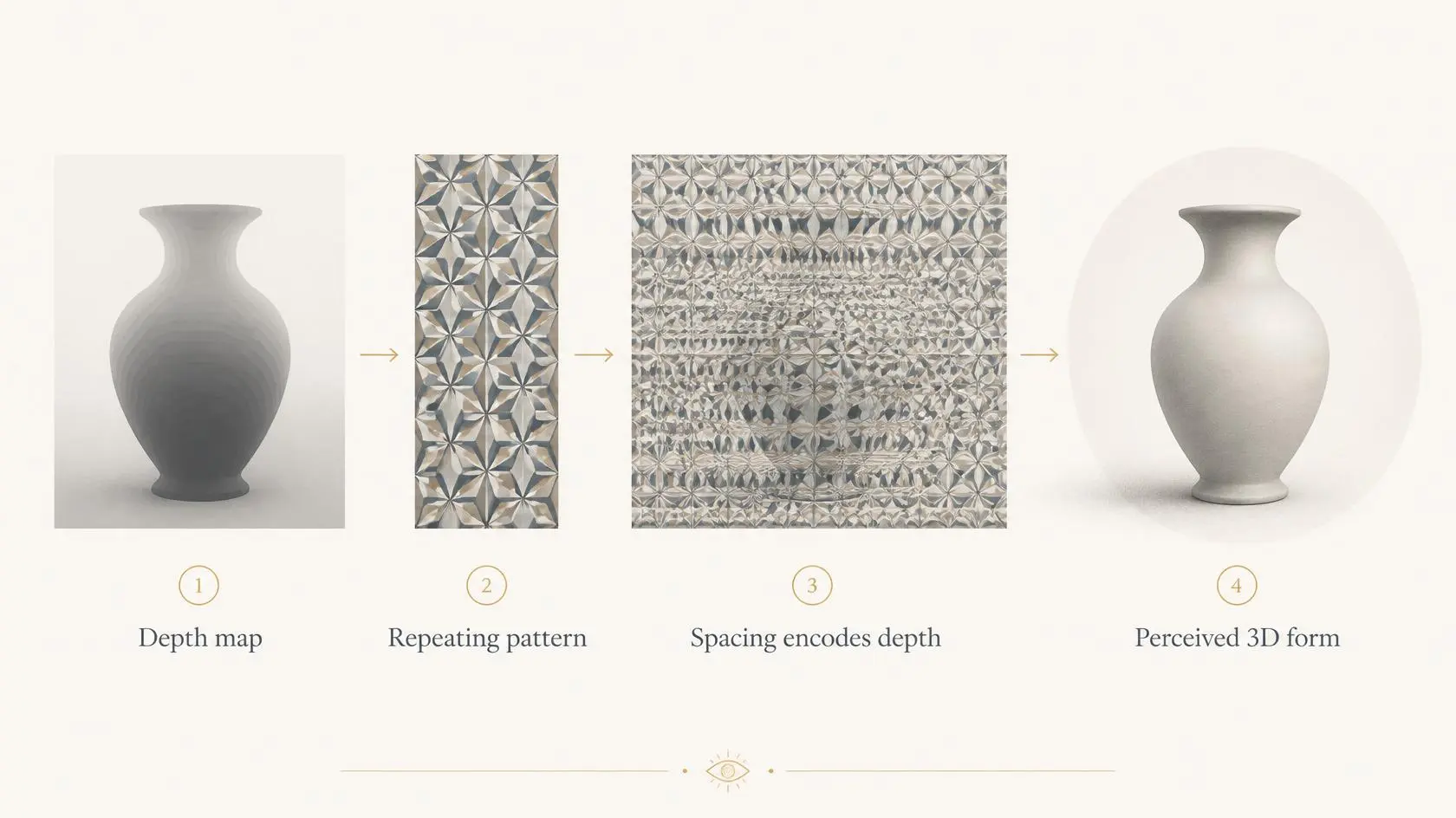
Where the depth map is black, the separation is the full 104 px and the pattern repeats exactly — a flat backdrop. Where the depth map is bright, the repeat tightens by up to a few dozen pixels, and that tighter rhythm is what the visual system reads as a raised surface. Crucially, the hidden shape is never drawn onto the picture. If you inspect the output pixel by pixel, there is no outline, no edge, no ghost — only a pattern whose repeat distance breathes. The image exists purely as a relationship between columns, which is why it is invisible to a single eye and to every camera.
Why constraint propagation matters: because each pixel copies from an already-decided pixel to its left, a depth change does not just affect one spot — it shifts the phase of every repeat downstream. Naive algorithms that resolve these chains carelessly produce smearing artifacts across the image; the strict left-to-right strip method keeps every constraint consistent by construction.
Why the object pops out (or in)
With parallel viewing, a tighter repeat means the eyes converge slightly more for that region than for the background, which the brain interprets as "nearer." With cross-eyed viewing, left and right views swap, disparities invert, and the same image reads as an engraving pressed into the page. Neither is wrong — they are two valid solutions to the same ambiguous matching problem. This site's images are authored for parallel viewing.
The limits of the illusion
The depth budget is finite: shifts much beyond a third of the period create matching ambiguity (the brain may "skip" a repeat, causing echo copies of the object), while shifts of only a pixel or two fall below many viewers' disparity threshold. That is why our depth control ranges roughly from 10 to 34 px against the 104 px period — a range that keeps the hidden surface both fusable and clearly separated from the background. Horizontal resolution matters too: depth exists only along the x-axis, so fine vertical detail in a hidden shape survives better than fine horizontal detail. Individual depth sensitivity also varies — the strength of stereopsis differs from person to person, so the same image can read vividly to one viewer and faintly to another.
A short history
Wheatstone's stereoscope (1838) established depth-from-disparity. Julesz's random-dot stereograms — developed at Bell Labs from the late 1950s onward, with the landmark Science paper appearing in 1964 — removed the need for recognizable content. Christopher Tyler and Maureen Clarke folded both eye-views into a single image in 1979, creating the first true autostereogram, later described in their 1990 SPIE paper. In the early 1990s, Tom Baccei, Cheri Smith, and Bob Salitsky's Magic Eye books turned the technique into a global craze, selling tens of millions of copies. Today the same mathematics runs in your browser tab — you can learn the viewing skill in our guide, or put the theory to work in the generator.
References & further reading
- Wheatstone, C. (1838). "Contributions to the physiology of vision — Part the first. On some remarkable, and hitherto unobserved, phenomena of binocular vision." Philosophical Transactions of the Royal Society of London, 128, 371–394.
- Julesz, B. (1964). "Binocular depth perception without familiarity cues." Science, 145(3630), 356–362.
- Julesz, B. (1971). Foundations of Cyclopean Perception. University of Chicago Press.
- Tyler, C. W., & Clarke, M. B. (1990). "The autostereogram." Proceedings of SPIE 1256: Stereoscopic Displays and Applications, 182–197.
- Thimbleby, H. W., Inglis, S., & Witten, I. H. (1994). "Displaying 3D images: Algorithms for single-image random-dot stereograms." IEEE Computer, 27(10), 38–48.
These sources cover the perception science and the core rendering algorithms behind single-image stereograms.